
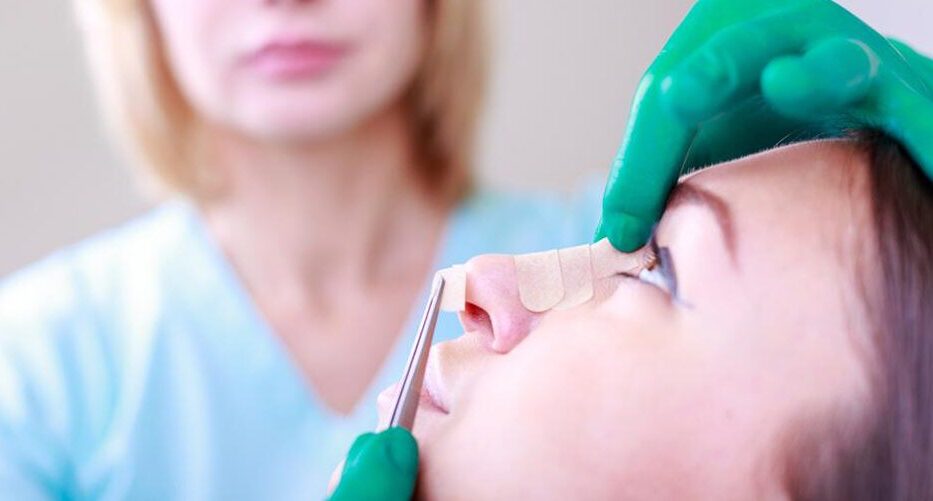
Rhinoplasty, sometimes referred to as a “nose job” or “nose reshaping” by patients, enhances facial harmony and the proportions of your nose. It can also correct impaired breathing caused by structural defects in the nose. However, it’s pivotal to notice that there will always be scarring after a surgery procedure which includes an incision in the skin and even though the scars will fade over time, they won’t disappear completely. Luckily, these scars are able to be minimized with clinically-proven solutions.
Read on to learn more about rhinoplasty procedure and what you can do to minimize subsequent scarring.
Rhinoplasty procedure
Here are the steps to a rhinoplasty, according to The American Society of Plastic Surgeons.
Step 1 – Anesthesia
Medications are administered for your comfort during the surgical procedure. The choices include intravenous sedation or general anesthesia. Your doctor will recommend the best choice for you.
Step 2 – The incision
Rhinoplasty is performed either using a closed procedure, where incisions are hidden inside the nose, or an open procedure, where an incision is made across the columella, the narrow strip of tissue that separates the nostrils. Through these incisions, the skin that covers the nasal bones and cartilages is gently raised, allowing access to reshape the structure of the nose.
Step 3 – Reshaping the nose structure
An overly large nose may be reduced by removing bone or cartilage. Sometimes surgery of the nose may require the addition of cartilage grafts. Most commonly, cartilage from the septum, the partition in the middle of the nose, is used for this purpose. Occasionally cartilage from the ear or rarely a section of rib cartilage can be used.
Step 4 – Correcting a deviated septum
If the septum is deviated, it can be straightened and the projections inside the nose reduced to improve breathing.
Step 5 – Closing the incision
Once the underlying structure of the nose is sculpted to the desired shape, nasal skin and tissue is redraped and incisions are closed. Additional incisions may be placed in the natural creases of the nostrils to alter their size.
Recovery
Healthline states that “after surgery, your doctor may place a plastic or metal splint on your nose. The splint will help your nose retain its new shape while it heals. They may also place nasal packs or splints inside your nostrils to stabilize your septum, which is the part of your nose between your nostrils”.
“You’ll be monitored in a recovery room for at least a few hours after surgery. If everything is okay, you’ll leave later that day”, says Healthline. However, in case the surgery procedure is somewhat complicated, you might have to stay in hospital for a day or two. To limit bleeding and swelling, you’ll want to rest with your head raised above your chest.
It is also recommended to apply an antibiotic cream to the surgical incision immediately when the incision has initiated the healing process and stopped bleeding to prevent harmful bacteria from infecting the affected area. Basically, the more damage done to the skin, the worse the scar will be. Thefore, proper wound care is extremely important for scarring minimization.
How silicone gel can help for scar management
Early in the postoperative period is the optimum time to start treating the area to prevent the abnormal scars such as keloids and hypertropic scars. Silicone gel technology is a clinically-proven treatment option for reducing the abnormal scars with over 30 years of evidence to support its safety and effectivenes. Silicone gel is recommended as the first-line topical scar treatment option by physicians, surgeons, and scar management experts. Silicone gel increases hydration of stratum corneum and thereby facilitates regulation of fibroblast production and reduction in collagen production, which results into softer and flatter scar. It allows skin to “breathe”. Additionally, silicone gel protects the scarred tissue from bacterial invasion and prevents bacteria-induced excessive collagen production in the scar tissue.
DTP Medical supplies the high quality silicone-based scar products such as Nourisil™ MD, Bapscarcare Gel, Bapscarcare Sheet. Ask your doctor which therapy option is right for you.
You don’t have to live with your unwanted scars. Try silicone-based scar products supplied by us today and see the difference!