
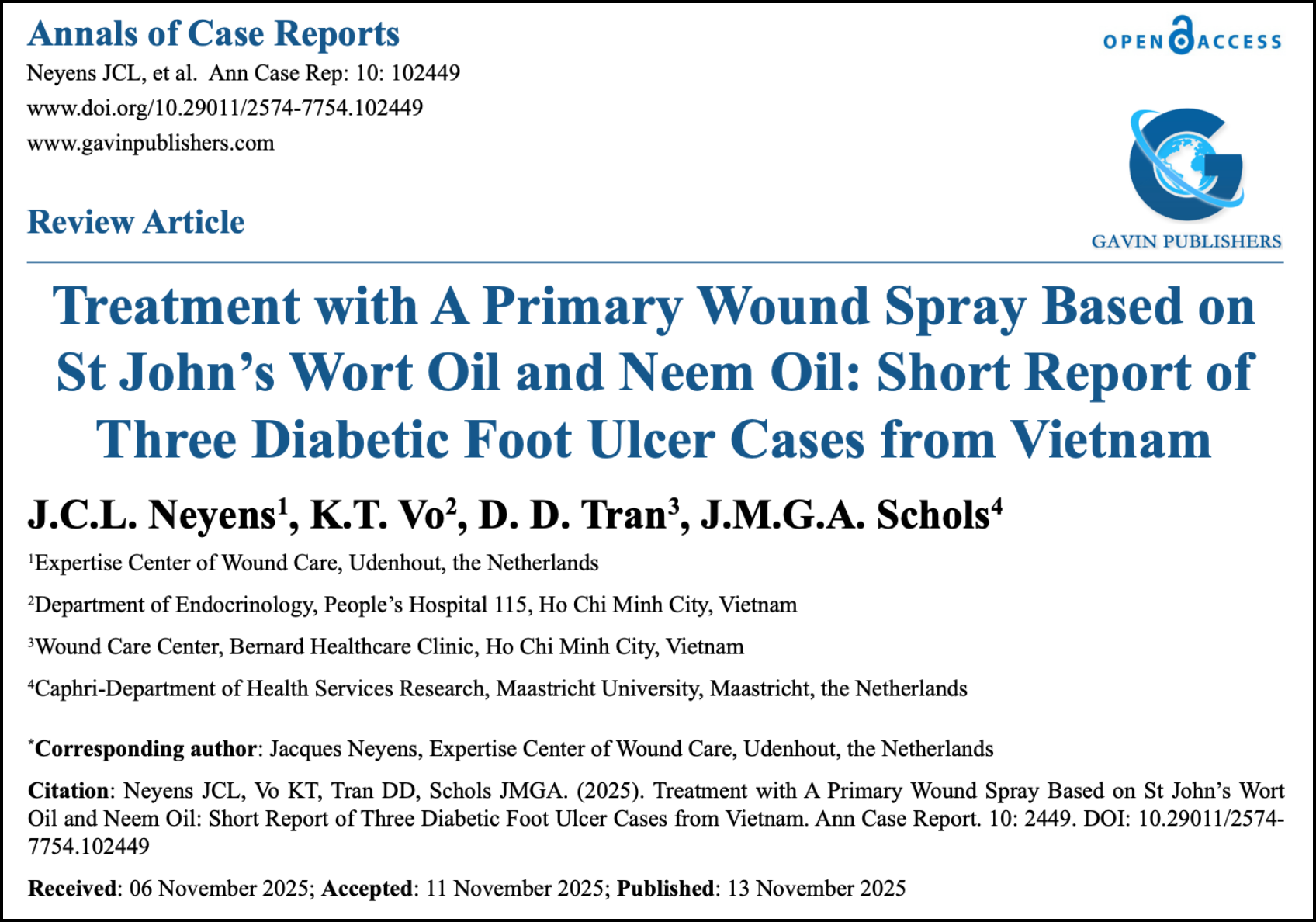
This article indicates a clinical case series conducted in Vietnam on patients with Diabetic Foot Ulcers (DFUs), aimed at evaluating the clinical efficacy, feasibility, and ease of use of WOUND – a primary wound spray formulated with St John’s Wort oil and Neem oil.
The scientific paper, titled “Treatment with A Primary Wound Spray Based on St John’s Wort Oil and Neem Oil: Short Report of Three Diabetic Foot Ulcer Cases from Vietnam”, was co-authored by Dr. Tran Doan Dao (Wound Care Center, Bernard Healthcare Clinic), Dr. Vo Tuan Khoa (Department of Endocrinology, People’s Hospital 115, Vietnam), Prof. Dr. J.M.G.A. Schols (Caphri-Department of Health Services Research, Maastricht University, Maastricht, the Netherlands), and Dr. J.C.L. Neyens (Expertise Center of Wound Care, Udenhout, the Netherlands). This clinical study was published in the Annals of Case Reports on November 2025.

Study Objectives
To evaluate the clinical application of WOUND as a primary wound spray in the treatment of DFUs, with a focus on:
•Facilitating the physiological wound healing process.
•Assessing the feasibility and convenience of administration in routine wound care.
•Evaluating treatment satisfaction and appreciation among patients and healthcare professionals.
Key study results:
Patients treated with WOUND demonstrated substantial clinical improvement across several key parameters:
- Induction of granulation tissue: The induction of granulation tissue formation was impressive, resulting in progressive filling up of the wounds and finally in re-epithelialization.
- Wound closure rate: One wound completely healed in 42 days. Two wounds partially healed in 42 and 28 days with a WSA decrease of 93% and 75% respectively.
- Peri-wound protection: In addition to promoting tissue repair, WOUND effectively protected the peri-wound area and preserved skin barrier integrity.
- No WOUND-related adverse events were documented throughout the study period.
- Feasibility and user satisfaction: The feasibility of application of WOUND was rated as high in all cases. The patients’ appreciation of WOUND was rated “very good”, the caregivers’ appreciation was rated “excellent and very good”.
Conclusions:
•WOUND represents a promising “non-touch” treatment option for the treatment of diabetic foot ulcers.
•Owing to its demonstrated clinical efficacy and ease of use, WOUND provides a versatile and practical solution for complex DFU care – both for professional use and self-management.
View the full study: Click here